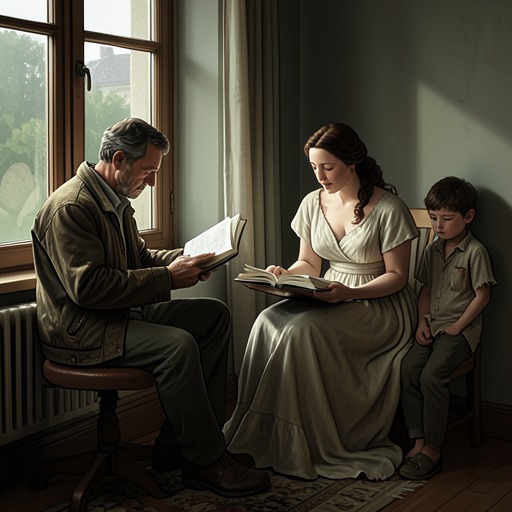
Clara Barceló's blindness
The Shadow of the WindClara Barceló's blindness is the first fact Daniel Sempere learns about her, but the novel soon makes clear that it is not the limit of her perception. Introduced through other people’s reactions to her eyes, she later uses touch to read Daniel’s face and describes books as opening an imaginative world that could give back the sight she had lost. Her story moves from being looked at as an object of pity or fascination to speaking as an experienced reader whose account changes Daniel’s understanding of books.
Identity and Introduction
When Daniel first meets Clara at Gustavo Barceló’s home, he notices her white pupils and realizes that she is blind. The scene is initially filtered through his startled gaze: her eyes and expression arrest his attention before he knows anything about her. Gustavo identifies her as his niece and presents her as the expert on Julian Carax, explaining that he has brought her along for that reason. The introduction therefore places disability and literary knowledge side by side, while making clear that Clara’s authority comes from her familiarity with Carax rather than from Daniel’s first impression of her.
Gustavo leaves Daniel alone with Clara and the book he has brought, giving them space to meet. Clara tells Daniel that he has earned her uncle’s respect by refusing the generous sum offered for the Carax volume. Her opening words establish her not as a passive subject of Daniel’s curiosity but as someone who notices the exchange and can explain its significance. The contrast is important: Daniel first reads her appearance, while Clara immediately reads his decision.
Touch and Perception
When Clara asks Daniel to come closer, she reaches out to find him. He takes her hand, and she offers her other hand; understanding what she wants, he guides it to his face. She then explores his features with her fingers, tracing his cheeks, forehead, hair, eyelids, and lips. The scene gives her an active means of perceiving another person: touch is not presented merely as a substitute mentioned in passing, but as the way she conducts this encounter and forms an impression of Daniel.
The episode also exposes the imbalance of their first meeting. Daniel has been staring at Clara, overwhelmed by the visible sign of her blindness, while she turns attention back onto him through touch. He becomes self-conscious under her examination, but Clara’s calm, deliberate gesture reverses the direction of scrutiny. The scene does not erase the practical reality of her blindness; instead, it shows that the encounter is shaped by different modes of perception, and that Daniel is not the only one who can observe and assess.
Reading as a Form of Sight
Clara explains that Julian Carax’s novel was the first book to draw her wholly into a story. Before it, reading had been a duty imposed by teachers and tutors, something she completed without understanding its purpose. Through the novel, she discovered the pleasure of imagination, beauty, mystery, language, and what she calls the recesses of the soul. Her distinction is not simply between one book and another: Carax’s fiction changes reading from an obligation into an experience she actively desires.
She compares the novel’s effect to the first spark of a kiss, a comparison that links literary discovery to an unforgettable first experience. Clara says the book taught her that reading could make her live more intensely and could give back the sight she had lost. In context, this is not a claim that a novel medically cures blindness. It describes what reading makes possible for her: an inward imaginative life that counters the limits other people might assume from her condition. A book that seemed to matter to no one else became consequential because of the life it opened for Clara.
Her account also explains why she became an expert on Carax. For years she searched libraries, bookshops, and schools for his other works, without success. She recounts a rumor about someone who sought out Carax’s books and burned them, a mystery that deepened the author’s obscurity. When her ill mother decided to return to Barcelona, Clara hoped the city where Carax was born and from which he disappeared at the beginning of the war might yield discoveries. Her interest thus joins personal attachment to reading with an active investigation into the fate of the writer and his books.
Narrative Significance
Clara’s blindness initially reaches the reader through Daniel’s startled response, which risks making her body a spectacle before her voice can be heard. The narrative complicates that first framing by giving her extended speech about reading and by showing her direct, purposeful use of touch. Her account supplies an interpretation of Carax’s fiction that Daniel does not yet possess, and her reading history becomes a source of knowledge rather than a decorative feature of her character.
The novel’s treatment remains connected to Daniel’s changing understanding. He is captivated by Clara’s voice and presence, but the enduring substance of their conversation is her description of what a book can do: turn reading into pleasure, intensify life, and make imaginative perception possible. Clara’s experience therefore broadens the novel’s recurring concern with books as forces that shape readers. Her blindness is materially real, while the meaning she makes through literature is neither a cure nor a simple metaphor; it is a personal account of reading that resists reducing her to the way others see her.